How to Use Whiskey Stones, and What They Actually Do
Published
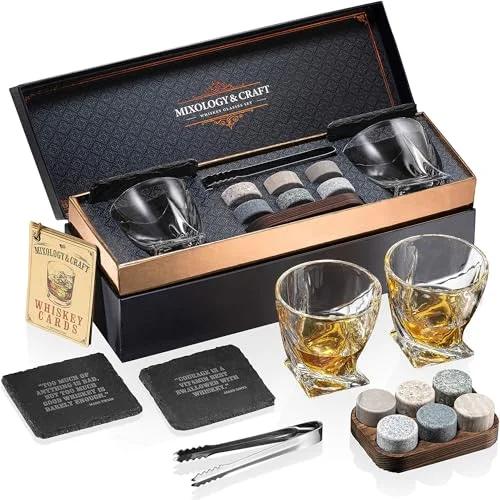
Freeze the stones at least 4 hours, drop 2 to 3 into a standard pour, wait two minutes, and sip. Expect the drink to cool 6 to 10°F with zero dilution. Whiskey stones will not make your drink ice-cold, and that is not a flaw: it is the job.
We sell whiskey stones, so take this next sentence as the credibility test: ice chills roughly three times harder than stone, and any brand promising an “ice-cold” drink from rocks is selling physics that does not exist. What stones really do is more specific, and for neat whiskey it happens to be exactly right. Here are the measured numbers, the science, and an honest decision guide.
How to Use Whiskey Stones, Step by Step
- Rinse new stones in warm water and dry them; they arrive with stone dust from cutting.
- Freeze for at least 4 hours. Most distillers say 4 to 6. Better: keep them in the freezer permanently, in their pouch or a zip bag so they do not pick up freezer smells.
- Add 2 to 3 stones for a standard 50 ml pour, 3 to 4 for a double. Tilt the glass and let them slide, not drop; even granite chips a rim on a hard landing.
- Pour the whiskey over the stones and give it a gentle swirl.
- Wait 1 to 2 minutes. Stone transfers heat quickly, so the chill arrives fast and then holds.
- Sip past the stones, and when the glass is done: rinse, dry, refreeze. That is the entire maintenance cycle.
One real safety note the gift boxes skip: never sip carelessly at the bottom of the glass. A stone sliding into your teeth is the most common way these sets get retired.
What Whiskey Stones Actually Do: the Measured Numbers
Independent testers have put thermometers in the glass, and their results agree with each other remarkably well:
| Chilling method | Measured temperature drop |
|---|---|
| 2 soapstone stones, 1 oz pour | about 10°F |
| Published stone tests, aggregated | 6 to 10°F |
| Thin frozen glass | about 15°F |
| Ice | 22°F and more |
| Thick frozen glass | about 25°F |
In the most-cited head-to-head, a 66°F neat pour sat at 56°F five minutes after stones went in, while the ice version had plunged to 44°F. So the skeptics are right that stones lose the cold-off against ice, and the marketing is wrong about “ice cold.” What both usually miss: whiskey professionals recommend serving neat whiskey around 60 to 65°F, because deeper cold mutes aroma and flavor. From a warm room, stones land you inside that window. Ice blasts straight through it.
The Physics: Why Ice Chills Four Times Harder
Melting is expensive. Turning ice into water absorbs 334 joules per gram before the temperature rises a single degree, while stone can only absorb about 1 joule per gram per degree as it warms. Run the numbers on equal volumes and ice soaks up roughly 3.8 times more heat than soapstone. Ironically, stone actually transfers heat faster than ice; it just runs out of capacity early. That is the whole story: stones are a small, fast, finite cold reservoir, and ice is a deep one that pays for its depth in dilution.
Whiskey Stones vs. Ice: Which Should You Use?
| Situation | Reach for | Why |
|---|---|---|
| Neat pour, standard proof | Stones | Gentle chill into the 60s°F, zero watering |
| Cask-strength / barrel-proof | A few drops of water or one cube | Dilution provably improves it (see below) |
| Cocktails, mixing | Real ice | You need the melt water and the deep cold |
| Hot day, long sipper | One large ice sphere | Big format melts slowest per degree of chill |
| Cold but strictly undiluted | Gel-filled steel cubes or a frozen glass | Deeper chill than stone, still no water |
Two notes from the science shelf. First, dilution is not always the enemy: a 2017 study in Scientific Reports simulated whiskey-water mixtures and found that added water pushes guaiacol, a key smoky-flavor compound, toward the surface of the drink, which is why a few drops open up a high-proof pour. Second, if you go the ice route for slow sipping, one big sphere beats a handful of cubes on melt rate, which is why ice ball molds became a whiskey-bar standard.
Soapstone vs. Granite vs. Stainless Steel
| Soapstone | Granite | Gel-filled steel | |
|---|---|---|---|
| Chill strength | Gentlest | Slightly stronger, holds longer | Strongest, longest |
| Glass safety | Softest on crystal | Hard; add gently | Hard; add gently |
| Care | Hand-wash | Dishwasher-safe | Dishwasher-safe |
| Character | Classic, neutral | Dense, neutral | Can read faintly metallic |
Our own sets run granite, the cube-shaped chilling stones and the glasses-and-stones gift sets, because granite is denser than soapstone, holds its cold a touch longer, and shrugs off the dishwasher. For drinkers who want the maximum no-dilution chill, we also make stainless steel ice cubes; they out-chill any stone, with the trade-offs the table shows. Whichever material, the mechanism and the maintenance are identical.
Cleaning and Caring for Whiskey Stones
- Rinse with warm water after each use; skip the soap unless something sticky was in the glass (stone is slightly porous to strong flavors).
- Dry completely before refreezing, or the stones fuse into a single archaeological find.
- Granite and steel can ride the dishwasher’s top rack. Soapstone and marble cannot; they are soft enough to scratch and chip.
- Store frozen in a sealed pouch. Stones sitting open in a freezer slowly adopt the freezer’s smell, and old-salmon whiskey is nobody’s dram.
Are Whiskey Stones Worth It? The Honest Verdict
Worth it, for the right drinker: the person who sips standard-proof whiskey neat, slightly cooler than room temperature, and hates what melting ice does to the last third of the glass. Not worth it as an ice replacement in cocktails, and the wrong gift for someone who drinks everything on the rocks by preference. As a gift, the honest pitch writes itself: it keeps the whiskey at full strength in the temperature window it was meant for, and it pairs naturally with a decanter set on the same shelf.
How We Sourced These Numbers
- Drinks and Drinking, Are Whiskey Stones Worth It?: the thermometer head-to-head (stones 10.3°F, ice 22.5°F, frozen glasses 14.9 to 25.2°F; the 66°F/56°F/44°F five-minute readings) and its aggregation of five other published stone tests (6 to 10°F consensus).
- Paleoseismicity, On the Rocks: how to cool whiskey adequately: the heat-capacity math: latent heat of fusion 334 J/g, soapstone ~1 J/(g·K), same-volume ice absorbing ~3.8× more heat, and stone’s higher thermal conductivity.
- Jameson, What Are Whiskey Stones?: freeze and per-pour counts (2 to 3 stones per 50 ml) and the material care split (granite/steel dishwasher-safe, soapstone/marble hand-wash).
- The Whiskey Wash, How to Use Whiskey Stones: the 4-hour freeze floor, stone counts, and the gel-filled steel comparison.
- American Institute of Physics, Why You Should Add Water to Your Whiskey: the 2017 Scientific Reports guaiacol simulation behind the cask-strength dilution advice.
- Flaviar, whisky glass and temperature guide: the 60 to 65°F neat-serving window.
Every temperature figure above is a published measurement or a range across published tests; none of it is our own lab work.
Frequently Asked Questions
Do whiskey stones actually work?
Yes, within honest limits. Published thermometer tests cluster around a 6 to 10°F drop, versus 20°F or more for ice, with zero dilution. That is enough to take a room-temperature pour down into the 60 to 65°F range most whiskey professionals recommend for neat sipping.
How long do you freeze whiskey stones?
At least 4 hours, and most distillers suggest 4 to 6. The simplest habit is storing them in the freezer full-time, so a chilled set is always ready when the bottle comes out.
How many whiskey stones per glass?
Two to three stones for a standard 50 ml (1.7 oz) pour, three to four for a double. More stone mass means more chill, but past four the glass gets crowded against your lip.
Are whiskey stones better than ice?
They do different jobs. Stones give a gentle chill at full strength; ice gives a deep chill plus progressive dilution. For cask-strength whiskey a little water is actually desirable, so an ice cube or a few drops works in its favor. For a standard-proof pour you want unwatered, stones win.
Why don't stones get my drink as cold as ice?
Physics. Melting ice absorbs 334 joules per gram through the phase change alone, while stone can only soak up about 1 joule per gram per degree as it warms. The same volume of ice absorbs roughly 3.8 times more heat than soapstone, so stone simply runs out of cooling capacity sooner.
Soapstone vs granite vs stainless steel: which is best?
Soapstone is the classic and the gentlest. Granite is denser, holds its cold slightly longer, and tolerates the dishwasher. Gel-filled stainless steel chills hardest and longest but can feel and faintly taste metallic against the glass. For neat whiskey most drinkers land on granite or soapstone.
How do you clean whiskey stones?
Rinse in warm water, wipe with a soft cloth, air-dry fully, then return them to the freezer. Granite and stainless steel handle a dishwasher cycle; soapstone and marble are softer and should be hand-washed.
Do whiskey stones change the taste of whiskey?
No. Non-porous granite and soapstone add nothing, absorb next to nothing, and dilute nothing. The only variable they touch is temperature, which is the entire point.
Chill it, don't water it
The Mixology & Craft whiskey stones gift set: granite chilling stones with two whiskey glasses, boxed and freezer-ready.
Shop Now